
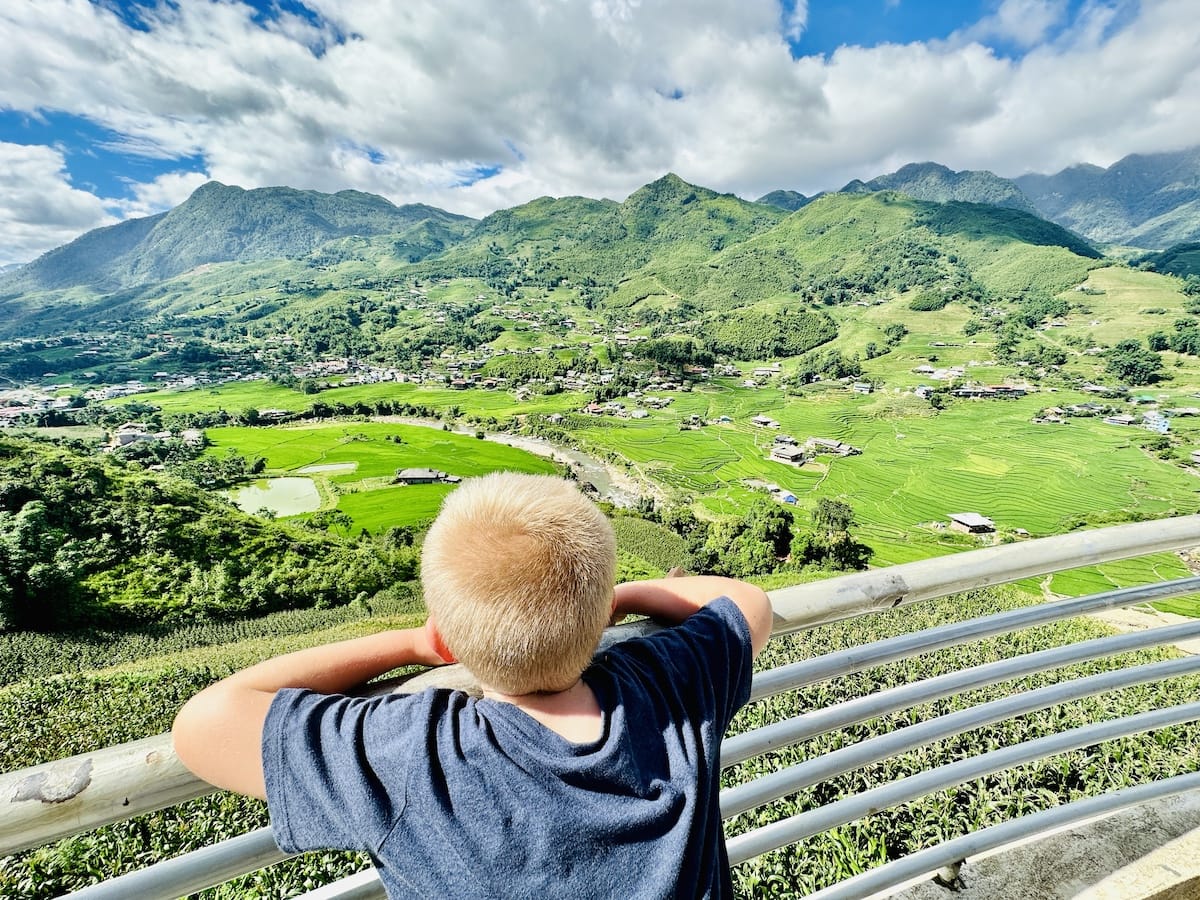
EDUCATION • DESTINATIONS
Where Do We Start?
How to choose your family’s first international trip – without getting paralyzed by the options.
You’ve decided to do it. Or you’re close to deciding. The dream has been sitting in the back of your mind long enough and you’re ready to make it real. The only problem is: the world is very large, your children are various ages and have various opinions, and every time you open a browser to start looking, twenty tabs later you are somehow more confused than when you started.
We have been there. Here is how we would think about it.
Start With What the Trip Is Actually For
Before you look at a single destination, answer this question: what do you want your family to walk away with?
This sounds like a philosophical question. It is actually a practical one, because the answer determines almost everything else.
- Cultural immersion — If the answer is “we want to experience a completely different culture and way of life,” your destination list looks one way.
- Adventure and nature — If the answer is “we want beautiful scenery, outdoor adventure, and hiking,” your destination list looks another way entirely.
- History and learning — If the answer is “we want history – the kind that makes the textbooks come alive,” you are looking at Europe, the Middle East, or Southeast Asia.
- Perspective and empathy — If the answer is “we want our children to understand how most of the world lives,” you are probably looking at a developing-world destination that requires more planning but delivers an experience that no amount of classroom education can replicate.
- Ease and access — If the answer is “we want a first trip that is spectacular but not overwhelming, and where English is widely spoken and infrastructure is excellent,” that narrows the list very helpfully.
Most families want some combination of the above. That’s fine. But having one primary answer keeps you from making the very common mistake of trying to do everything on a first trip and doing none of it particularly well.

The Four Variables That Determine Your First Trip
1. The Ages of Your Children
Age matters less than most families think — but it does matter. Here is how we think about it:
Children under three are the most logistically demanding but the least emotionally complicated. They do not have opinions about itineraries, they sleep when they need to sleep, and they adapt to new environments with remarkable flexibility. The hard part is the gear, the schedule disruption, and the sheer physical work of carrying a non-walking child through airports and up cobblestone streets. Stroller-friendly destinations – Western Europe, Japan, Australia, New Zealand – are significantly more manageable than the alternatives. An international trip with a toddler is possible. We’ve done it. Just plan extra time for everything and lower your pace expectations.
Children aged four through ten are, in our experience, wonderful travel companions. Old enough to remember the experiences, young enough to still be enchanted by novelty, and physically capable of real hiking and activity. These are the years to be most ambitious.
Children aged eleven through fourteen are starting to have real opinions and real interests. Involve them in planning. A thirteen-year-old who helped choose the destination is a fundamentally different travel companion than one who was informed of the destination two weeks before departure.
Teenagers (fifteen and up) are full-fledged travel companions when engaged properly. They can carry their own bags, help with the younger children, navigate a subway system, handle a long travel day, and contribute genuinely to group decisions. They are also more than capable of making a trip miserable if they feel like travel is something being done to them rather than with them. Include them.
2. Your Family’s Existing Comfort Level
A family that has never taken an international trip should not book Asia as their first adventure. Not because it’s beyond you – it may not be – but because every trip builds skills and confidence that make the next one better. Your first international trip will have more uncertainty, more logistical friction, and more moments of “we have no idea what we’re doing” than any subsequent trip. The destination should allow space for that learning curve.
First-trip destinations that work particularly well for families new to international travel:
- English-speaking countries (UK, Ireland, Australia, New Zealand) — English is widely spoken, the infrastructure is excellent, the food is approachable, the safety profile is very good, and the activities are varied enough for every age. Australia and New Zealand in particular offer extraordinary outdoor adventure alongside modern amenities.
- Western Europe — Western Europe (France, Italy, Spain, Portugal) is the most popular first international destination for American families for good reasons: it is familiar enough not to be overwhelming, it is extraordinary enough to be transformative, and a decade of Instagram has prepared every child in your family to recognize the Eiffel Tower.
- Costa Rica — Easier to navigate than most of Asia, genuinely beautiful, increasingly accessible from the US, and the combination of cloud forest, beaches, wildlife, and adventure activities makes it one of the best value-per-experience destinations on the planet for families.
- Mexico — Mexico – not just Cancun, but Mexico City, the Yucatan Peninsula – is an underrated first international destination. It is closer, cheaper, and less logistically complicated than any other option on this list, and the cultural richness is real.
3. Your Budget
Budget has two components: the actual cost of the trip, and the opportunity cost of waiting until you have more.
On the actual cost: flights are the biggest variable, and they are more manageable than most families assume once you have access to cheap flight deals and a points strategy in place. Our general practice is to have a list of a few places we would love to go next, and then wait to see what flight deals come across our emails over the coming months. When the $400 round-trip ticket to Tokyo pops up, we are ready to book it immediately! See our full guide on how we fund our trips for the specific mechanics. For ground costs – accommodation, food, activities – vacation rental properties (Airbnb, VRBO) are almost always more economical than hotels for families of five or more, often dramatically so.
On the opportunity cost: a trip that costs $12,000 today will not cost less in five years. Airfare adjusts with inflation. Hotels adjust with inflation. The activities and experiences you want to have are not becoming cheaper. Waiting for a budget that is “more comfortable” is, in practice, waiting indefinitely.
4. How Much Time You Have
Most of the best international family destinations are not accessible on a long weekend. Plan for at minimum ten days, ideally at least two weeks. We shoot for a month to really experience the place, but realize that this is not often feasible. You need a couple of days to adjust to the time zone and hit your stride, and then you need actual time to be somewhere rather than just passing through it.
The families we know who have the best travel experiences are the ones who go to fewer places and stay longer. The families who are most exhausted and least satisfied are the ones who tried to do six countries in ten days. Resist the temptation to maximize destinations. Maximize time in each place instead.

Our Specific Recommendation for Most Families
If you asked us to pick one first international trip for a family with children between the ages of five and fifteen, on a budget that is real but not unlimited, with one to two weeks available: we would say Western Europe, with a focus on two or three cities rather than a grand tour.
London plus Paris is the most battle-tested first international trip in the world for American families. Here is why it works:
- English is spoken in London, which removes the language barrier for at least half the trip and gives families time to build confidence before crossing into France.
- The bucket-list density is extraordinary. The Tower of London. Westminster Abbey. The West End. Versailles. The Eiffel Tower. Notre Dame. The Louvre. Any one of these would be a meaningful experience in isolation. Together, they make a trip that every member of the family will reference for the rest of their lives.
- The infrastructure is excellent. The airports are large and navigable. The train between London and Paris (the Eurostar through the Chunnel) is an adventure in itself. The vacation rental market in both cities is mature and well-supplied for large families.
- The food is good and approachable. Children who are not adventurous eaters will find familiar options. Children who are will find extraordinary ones.
- It is a manageable trip to plan. Unlike Southeast Asia or Africa, which require more research and more logistical complexity, London-Paris is well-documented. Information is abundant. You are not the first family to do this, and that is an advantage on a first trip.
We did exactly this trip (adding in a week in Rome and Venice) in January 2020 with six children ranging in age from two to fourteen. It changed our family. It started everything.
The first trip is the hardest one to plan because it requires the most imagination. After you’ve done it once, the next one is easier. And the one after that is easier still. The only way to get to the second trip is to take the first one.
A Few Things Not to Overthink
First-time international travelers worry about things that, in practice, are rarely the problem. In the interest of saving you the anxiety:
- Your children will be fine on the plane. Long flights with children are not as bad as you fear. Download movies. Pack snacks. Accept that it will be imperfect. It will also end.
- You will make wrong turns. You will go to the wrong metro stop. You will stand in front of a restaurant for five minutes deciding whether to go in, then go somewhere else. This is not a failure of planning. This is what international travel actually is, and it is one of the best parts.
- The food will not be a crisis. Children eat. They find things they like everywhere. If your child subsists on bread and cheese for a week in France, they will survive and will have a funny story to tell.
- You do not need to see everything. Pick fewer things and experience them fully. The family that spends two hours at the Eiffel Tower, watching the light show and eating crepes and watching the city hold its breath before the tower erupts into light, will remember it longer than the family that saw twelve museums that day.
- Something will go wrong. This is not a warning. It is a promise. And it will often be, in retrospect, one of the best parts of the trip. The stories we tell most often from our six years of travel are not the things that went perfectly. They are the customs agent in Buenos Aires, and the sprint through the Ethiopian airport, and the night a GPS led us down a dark road in the Black Forest in search of a Burger King that did not exist. Plan as well as you can. Then enjoy the parts you didn’t plan for.
Ready to Go Further?
Once you’ve chosen your destination, explore our destination-specific guides for practical advice on itinerary, accommodation, activities, and what we would do differently if we went back. And if you’re still deciding, browse our trip posts — every destination we’ve visited is documented in enough detail to help you make the call.
Pick somewhere. Book something. Go.
The world is more manageable than it looks from here.
Families Who Travel • familieswhotravel.com • Where Do We Start?